December 12, 2025
About the different states of mind, including rational, emotional, and wise mind, and how they impact mental health.
When people search for about the different states of mind, they are often trying to understand why they think, feel, or react the way they do. The “States of Mind” framework—commonly used in Dialectical Behavior Therapy (DBT) and mindfulness-based psychiatry—offers a powerful, accessible way to understand human cognition and emotional regulation.
The model, illustrated in the reference image, describes three primary states:
Rather than labeling one state as “good” or “bad,” modern psychiatry recognizes that mental health depends on flexibility—the ability to move between states and integrate them effectively.
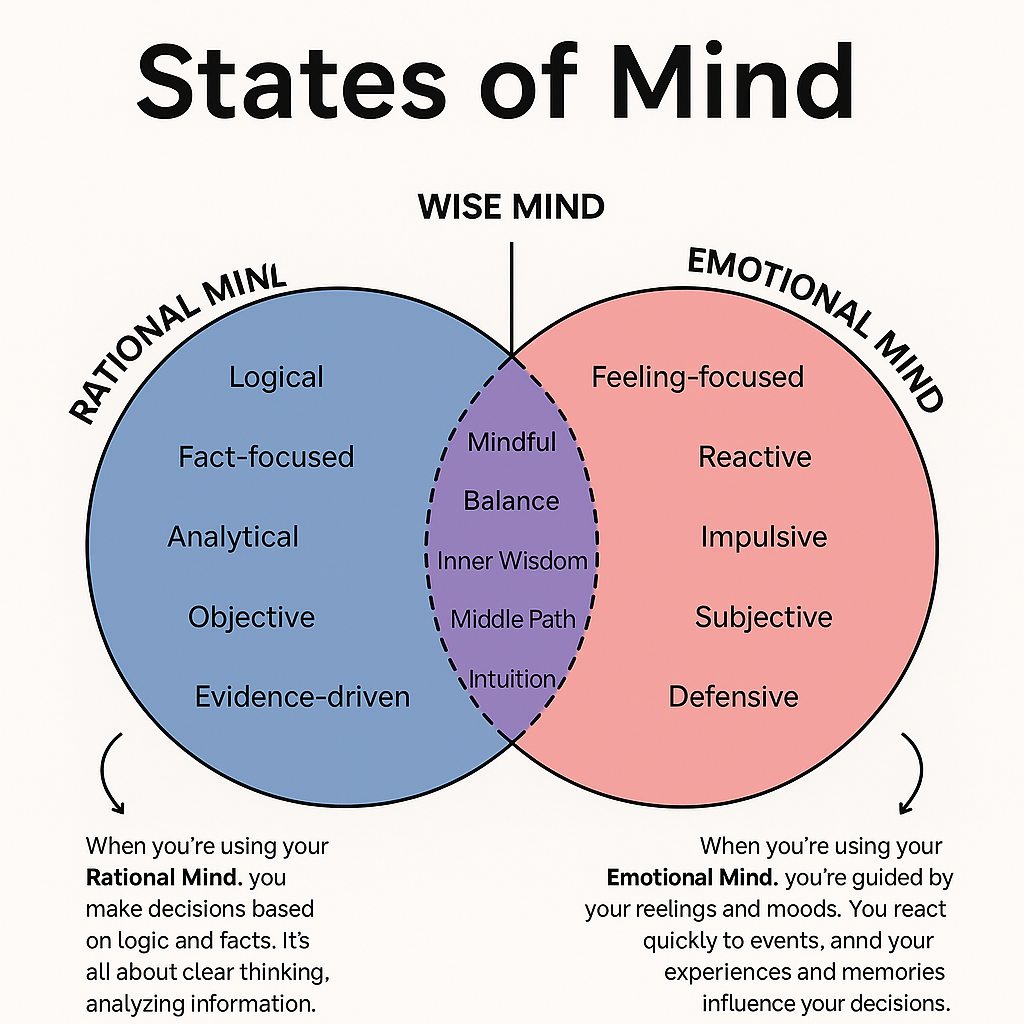
Rational Mind is governed by logic, evidence, and objective reasoning. When operating in this state, individuals rely on facts, data, and analytical thinking. This state is essential for problem-solving, planning, and decision-making in professional or academic settings.
However, an overreliance on Rational Mind can create emotional disconnection. People may dismiss feelings as irrelevant or “illogical,” which can contribute to burnout, relational difficulties, or untreated depression. In conditions like ADHD, difficulty sustaining Rational Mind may appear as disorganization or impaired executive functioning—often evaluated by specialists in adult ADHD psychiatry.
Evidence-based therapies such as cognitive behavioral therapy (CBT) help individuals strengthen Rational Mind without suppressing emotional experience.
Emotional Mind is driven by feelings, moods, and bodily sensations. In this state, decisions are shaped by emotional intensity rather than logic. Emotional Mind is not inherently problematic—it allows humans to connect, empathize, and respond to danger or attachment needs.
However, when Emotional Mind dominates, individuals may become reactive, impulsive, or defensive. This is commonly seen in anxiety disorders, trauma-related conditions, and mood disorders such as depression. In obsessive-compulsive disorder, heightened Emotional Mind may amplify fear-driven compulsions, a focus of specialized care in OCD psychiatry.
Emotional dysregulation is also a core feature of borderline personality disorder, where treatment approaches like DBT and medication strategies—outlined in clinical BPD treatment insights—are often essential.
Wise Mind exists at the intersection of Rational and Emotional Mind. It represents balanced awareness—where logic and feelings inform one another rather than compete. Wise Mind is associated with intuition, mindfulness, and inner wisdom.
In DBT, Wise Mind is a central therapeutic goal. Practices taught in dialectical behavior therapy (DBT) help individuals pause, observe, and choose responses aligned with long-term values rather than short-term emotional urges.
Wise Mind is particularly important in recovery from trauma, addiction, and mood instability. Treatments such as EMDR and mindfulness-based interventions help strengthen access to this integrated state.
Understanding the different states of mind offers insight into a wide range of psychiatric conditions:
In more severe conditions, medication—such as carefully managed antipsychotic treatment—may be necessary to stabilize cognition and restore access to Wise Mind.
Psychiatric treatment today goes beyond symptom suppression. Integrative models combine psychotherapy, medication, neuroscience, and lifestyle factors. Innovations in AI-informed psychiatry are helping clinicians better understand patterns of cognition, emotion, and behavior across states of mind.
For individuals with treatment-resistant depression, emerging approaches like ketamine-assisted therapy may support cognitive flexibility and emotional processing under expert supervision.
Attention to identity, gender, and neurodiversity is also critical. Specialized care addressing men’s mental health, LGBTQ mental health, and neurodevelopmental conditions such as autism ensures treatment aligns with lived experience.
Learning about the different states of mind empowers individuals to:
This framework is widely used in psychiatric assessment and therapy because it is intuitive, non-pathologizing, and actionable.
Integrative Psych provides comprehensive psychiatric care grounded in neuroscience, psychotherapy, and personalized medicine. Our clinicians help patients understand their internal states, regulate emotions, and restore balance across Rational, Emotional, and Wise Mind.
Learn more about our multidisciplinary team of experts or schedule an initial psychiatric consultation to explore treatment options tailored to your needs.

We're now accepting new patients